
How to Use AI to Study for Any Exam: Subject-Specific Prompt Templates That Actually Work
There is a specific feeling that arrives about three days before an exam when you realize that the hours you spent reading and highlighting and summarizing have produced a version of studying that looked like studying and felt like studying but left you unable to actually answer the questions. The information went in. It did not stay in the way you needed it to stay. You read the chapter. You cannot reproduce it without looking at it.
Most students who turn to AI at this point end up in the same place within a week. Because the way almost everyone uses AI to study is asking it to explain things, then reading those explanations. Which is the same passive activity that produced the original problem, just with AI generating the text instead of the textbook printing it.
For documents that are dense or technical rather than just long, AI translation and rewriting tools can convert academic language into something much easier to work with before you start studying.
The students getting real results from AI-assisted studying are not using it as a summarizer. They are using it as a tutor that tests them, challenges their thinking and returns to their weakest areas. Getting AI to behave that way is entirely a question of how the prompt is written. Every template in this guide is built for exactly that purpose.
Why “Explain This Topic” Is the Wrong Starting Point
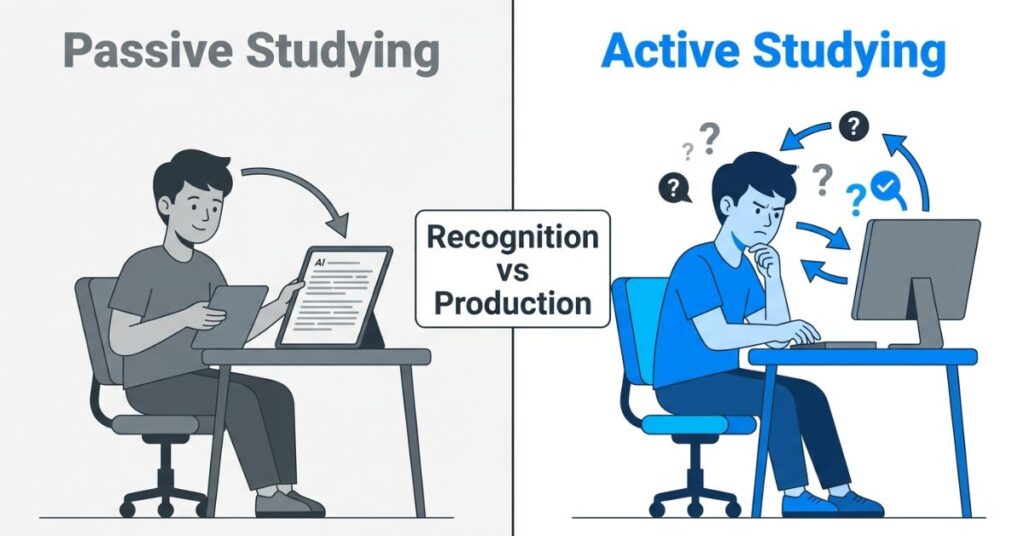
There is a specific cognitive trap that catches almost every student who reads through material before an exam. Familiarity feels like knowledge. The concept seems recognizable. You have definitely encountered this before. The feeling of recognition is so convincing that it is genuinely easy to mistake it for understanding, right up until the exam question asks you to produce the information without the page in front of you and nothing reliable surfaces.
This is not a failure of intelligence or effort. It is a failure of technique. Recognition-based studying produces recognition-based knowledge: it functions when the answers are visible and collapses under the conditions of an actual exam, which is almost always a production task. You are asked to generate, argue, calculate, and apply without any scaffold other than the question itself.
An AI asked to “explain photosynthesis” produces a summary you read passively and feel more familiar with. An AI asked to “test my understanding of photosynthesis by asking me questions and guiding me when I get stuck rather than giving me the answer immediately” produces a session where you are retrieving, making errors in real time, being redirected, and correcting your own thinking. The second kind of session is more uncomfortable than the first. That discomfort is the signal that it is working. Discomfort in studying is not something to smooth over. It is the feeling of your brain doing the thing it needs to do to retain information under exam conditions.
The Master Prompt That Opens Every Session
Before any subject-specific prompt, every effective AI study session needs one context-setting message. Without it, the AI defaults to its most common mode with students: helpful, thorough, and passive. The master prompt converts it into something that actually challenges you.
I am studying for [exam name and level, e.g. A-Level Biology / First Year University Law / IELTS Academic / Medical Board Part 1]. The exam is in [timeframe, e.g. three weeks / on specific date]. My current understanding of [subject] is: [honest self-assessment, e.g. strong on concepts but weak on application / confident with theory but struggle with calculations / know the content but cannot structure essay answers well under time pressure]. The exam format is [multiple choice / written essays / problem-solving / practical / oral].

For this session, act as a tutor who challenges my understanding rather than confirms it. When I answer incorrectly or incompletely, do not give me the full answer immediately. Guide me toward it with a hint or a Socratic question. Keep a note of topics where I make errors and return to them later in the session using a different question format.
The self-assessment line matters more than any other part of this prompt. Students consistently overestimate their knowledge of recently studied topics and underestimate topics covered earlier, because familiarity is strongest for recent material and weakest as a predictor of actual exam performance. The topics that feel comfortable are often where the gaps are most expensively hidden. Write the self-assessment more honestly than feels comfortable. The sessions that follow will be more productive than the ones that started with an optimistic one.
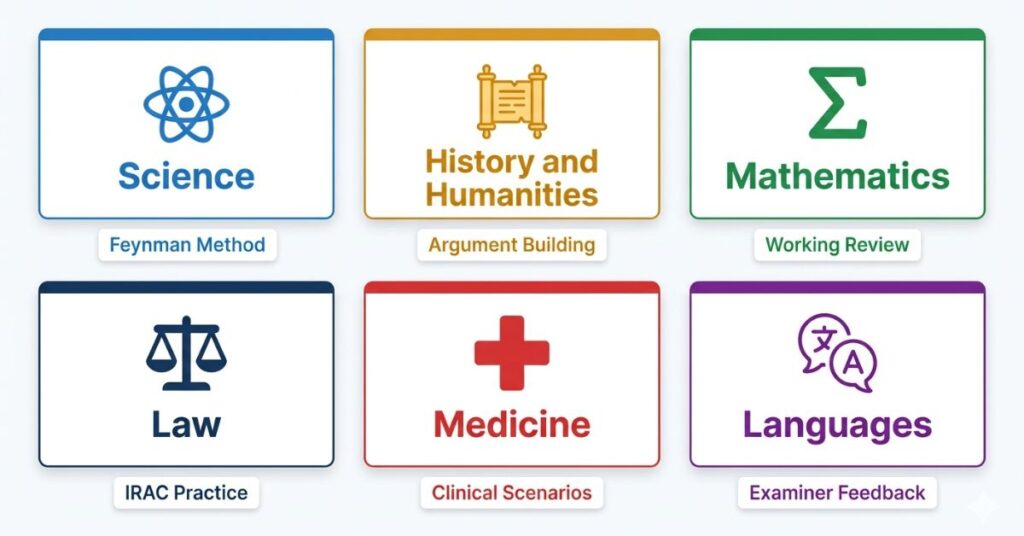
Subject-Specific Prompt Templates
For Science: Biology, Chemistry, Physics
The specific failure pattern in science exams is one almost every science student recognizes in retrospect. You can follow the textbook derivation when the steps are in front of you. You cannot reproduce the first step independently, you know what the Krebs cycle does. It’s not possible to explain why each step matters mechanistically without prompting. The understanding is real but surface-level, and science exams are specifically designed to probe the boundary between the surface and what is beneath it.
The Feynman Explanation Prompt. Start Every Science Topic With This:
I am studying [specific topic, e.g. cellular respiration / titration / Newton's laws of motion]. I will explain it to you in my own words exactly as I currently understand it. Do not add to or improve my explanation immediately. First, identify any misconception, missing step, or imprecise language in what I said. Then ask me one question about the part I explained least clearly. Here is my explanation: [write your explanation here]This technique is named for physicist Richard Feynman, who used it throughout his career as both a learning and a testing tool. The principle is that the gap between thinking you understand something and actually understanding it becomes visible the moment you try to explain it without notes. The gap shows up as hesitation, vague language, or the moment you realise you have been using vocabulary without knowing what the words mean at a mechanistic level.
It is the most consistently revealing technique available for studying any concept-based subject. It is also the one students avoid most reliably, because it makes the gap undeniable rather than ignorable. The students who use it regularly tend to stop being surprised by their exam results.
Application Problem Prompt:
Give me three exam-style application questions on [specific topic] at [level] difficulty. Present them one at a time. After I answer each one, tell me what I got right, what I missed, and whether I applied the correct principle or arrived at a right answer through flawed reasoning. Do not show the next question until I have properly reviewed my answer to the current one.Mistake Pattern Prompt. Use Directly After Any Practice Paper:
I just completed a practice paper on [subject]. The questions I got wrong or was uncertain about covered these topics: [list them]. Rather than explaining each mistake individually, identify which underlying concept or skill connects these errors. Then create a five-question mini-test specifically targeting that underlying issue.For History, Social Sciences and Humanities
History and humanities students face a failure mode that is specifically demoralising because it happens to hardworking students who genuinely prepared. They walk in knowing the events, the context, the key figures, the chronology. They walk out with a C when they expected a B, and they cannot understand why, because the information was all there.
The marks they lost were not for facts. They were for argument quality: the ability to take a position, defend it analytically, and engage honestly with the evidence that complicates it. Reading more content does not develop this skill. Practising the construction of arguments under time pressure is what develops it, and most students do almost none of this before sitting in the exam room and attempting it for marks for the first time.
Argument Building Prompt:
I am preparing an essay on this question: [paste the question]. Before I write anything, give me five distinct analytical arguments I could make in response, ranging from the most mainstream interpretation to the most interesting defensible counterargument. For each argument, give me one piece of supporting evidence and one piece that complicates or challenges it. I will then tell you which arguments I plan to use and explain my reasoning for the selection.Source Evaluation Prompt. For History and Politics:
Present me with a primary or secondary source related to [topic or period]. I will analyse it for reliability, provenance, context, and usefulness to a historian studying this subject. After my analysis, tell me what a top-band response would have included that mine did not, and identify any contextual knowledge I missed or significantly underweighted.Timed Essay Marking Prompt:
I have 45 minutes to write an essay answering: [question]. I will write my thesis statement and introduction plan first. Before I write the full essay, tell me whether my argument is genuinely arguable and focused, or too broad, too descriptive, or drifting toward narrative. After I submit the complete essay, mark it against [exam board or level] criteria, give me a provisional grade, and identify the two or three specific changes that would move it one grade band higher.For Mathematics and Statistics
Mathematics has an honest limitation when it comes to AI studying, and acknowledging it produces better outcomes than working around it. AI handles mathematical reasoning, method, and conceptual understanding well. It makes occasional errors in complex multi-step arithmetic. The more significant limitation is that it cannot see your working, and working is where marks are lost in mathematics.
Every maths student has had the experience of completing a problem, arriving at a wrong answer, checking each step repeatedly, and being unable to find the error. It only becomes visible when someone else looks at the working and identifies the exact line where the reasoning quietly slipped. There is a specific frustration in that moment, because the error was invisible to you from the inside, and finding it required another set of eyes. These prompts replicate that external perspective.
Method Confirmation Prompt:
I am about to attempt a problem involving [technique, e.g. integration by parts / chi-squared test / matrix inversion]. Before I start, explain why this technique is appropriate for this type of problem and what distinguishes it from similar approaches I might confuse it with. Do not solve the problem. After your explanation, I will attempt it and type my working step by step.Working Review Prompt:
Here is my step-by-step working for a [type of problem]: [type each step clearly]. Find the first error in my reasoning or calculation. Tell me which principle or rule I misapplied at that step. Do not identify subsequent errors until I have corrected the first one and reattempted from that line onwards.Proof Verification Prompt:
I am constructing a proof for [theorem or statement] and will submit it one step at a time. After each step, tell me whether it follows logically from the previous one and whether I have made any unjustified assumptions. Do not wait until the end to comment. Interrupt the proof at the first where something does not follow.For Law
There is a particular kind of law exam failure that is painful specifically because the student knew the material. They knew the cases, the rules. They sat the problem question and what they produced was a response that recited the law without applying it to the specific facts in front of them. The examiner rewards application. The student delivered information. The grade did not reflect the preparation and the student could not understand why, because the knowledge was real.
The gap between rule knowledge and rule application is the specific gap that legal AI prompts address most effectively. The AI can generate unlimited novel fact patterns that a student has never seen before, test case retrieval in a way that flashcard repetition cannot replicate, and evaluate IRAC responses with enough specificity to reveal exactly where the application slipped without reaching the conclusion.
IRAC Problem Prompt:
Create a problem question on [area of law, e.g. negligence / contract formation / criminal mens rea] at [level] standard. I will answer using the IRAC structure: Issue, Rule, Application, Conclusion. After my answer, tell me: which legal issues I failed to spot, where my rule statements were incomplete or imprecise, where my application stayed too close to restating the rule rather than engaging with the specific facts provided, and whether my conclusion was adequately supported by the analysis before it.Case Recall Prompt:
Test me on the key cases in [area of law]. Give me a brief summary of the material facts and ask me to identify the case, the principle it established, and any important limitations on that principle. If I cannot name the case, give me only the first party's surname as a prompt before revealing the full citation.Statute Interpretation Prompt:
I will paste a provision from [specific statute]. Ask me questions that require me to interpret its literal meaning, identify any ambiguity in the drafting, apply it to a hypothetical scenario, and consider how a court might construe it purposively. Increase the complexity of each subsequent question based on how accurately I answered the previous one.For Medicine and Nursing
Medical studying carries a specific weight that most other subjects do not. The awareness that the content matters beyond the grade, that misremembering a contraindication is not just a mark lost but eventually a clinical error that affects a real patient, sits quietly in the background of every session. Medical exam anxiety is different in character from most other exam anxiety because it is not purely about performance. It is about competence, and the distance between what you know in a study session and what you can produce under OSCE pressure is a gap that students feel acutely and often cannot accurately assess from the inside.
AI does not eliminate that anxiety. What it does is give it somewhere productive to go. The clinical scenario prompt creates a version of the uncertainty of a real clinical encounter within the safety of a study session, which is precisely where making errors and being guided through them has learning value rather than consequences.
Clinical Case Prompt:
Present me with a clinical case relevant to [body system or specialty, e.g. cardiovascular, respiratory, paediatrics]. Include the presenting complaint, relevant history, and initial observations. Do not tell me the diagnosis. I will give my differential diagnoses in order of likelihood, explain my reasoning for each, and describe what additional history, examination, and investigations I would want. If I miss something clinically important, guide me with a question rather than stating what I missed.Drug Knowledge Prompt:
Test me on [drug or drug class]. Ask me in sequence: mechanism of action, clinical indication, contraindications, significant adverse effects, key monitoring parameters, and one commonly tested drug interaction. For each answer, tell me not just whether I am correct but whether I gave the depth a clinical examiner would reward or a surface-level version that would cost marks in an OSCE.Pathophysiology Linking Prompt:
I can describe the symptoms of [condition] but want to understand the mechanism behind each one. Present each major symptom individually and ask me to explain the underlying pathophysiology. If my answer is anatomically correct but mechanistically shallow, ask me to go one level deeper before we move to the next symptom.For Language Exams: IELTS, TOEFL, A-Level Languages, Language GCSEs
Language exam preparation has a frustrating problem that other subjects do not share. The feedback loop breaks when you are still learning the language and you cannot reliably identify what is wrong with your writing because you do not yet have full command of the standard you are being assessed against. You can feel that a sentence is off without being able to say why. You finish a practice essay, read it back, sense that something is not right, write a version that feels slightly better and have no real way of knowing whether it is or whether you have simply traded one category of error for another.
This is the gap AI closes most effectively for language learners. Not by teaching the language itself, but by providing on demand the kind of specific examiner-standard feedback that usually requires a scheduled session with a qualified teacher. At eleven at night, on the fourth draft of a Task 2 essay, for any piece of writing you produce.
Writing Feedback Prompt:
I am writing a [task type, e.g. IELTS Task 2 academic essay / GCSE French informal letter / A-Level Spanish analytical response] on this topic: [topic]. After I submit it, evaluate it against the specific marking criteria for [exam]: task achievement, coherence and cohesion, lexical resource, and grammatical range and accuracy. Give me an estimated band or grade with specific examples from my writing that justify each score. Then give me three targeted improvements with examples showing how I could have rephrased specific sentences to achieve a higher mark.Vocabulary in Context Prompt:
I am building academic vocabulary for [exam level] in [language]. Give me ten words or phrases at the appropriate level. For each, give me the term, a plain-language definition, a natural example sentence, and the most common mistake learners make when using it. After I have reviewed all ten, test me with fill-in-the-blank sentences where I must choose the correct word and explain why the alternative does not fit.Speaking Practice Prompt:
Act as a [exam name] speaking examiner. Give me a cue card topic or speaking question at the appropriate level. I will write my response as though speaking. Evaluate my use of discourse markers and fluency signals, vocabulary range, grammatical accuracy, and whether I addressed all parts of the question. Then suggest three specific phrases I could have used to demonstrate a higher language level.What Actually Matters More Than Having the Right Prompts
Here is the thing most AI study content does not say plainly, because it complicates the message and nobody wants to read it at midnight two days before an exam. The best prompts in the world, used in five consecutive intensive sessions in the days before the exam, will not produce the retention that moderate prompts distributed across three weeks produce.
Memory does not work on the timeline that exam anxiety assumes. Information encoded under stress the night before is available the next morning and significantly degraded within a week. Information encoded across spaced sessions with sleep between them consolidates differently, because sleep is when memory consolidation actually happens. The neuroscience on this is not contested or nuanced. It is one of the most robust findings in cognitive science and one that exam culture ignores enthusiastically every year.
What makes this specifically relevant to AI study tools is that AI makes intensive sessions feel more productive than they are. The session output looks thorough. The engagement feels substantive. The familiarity that follows a well-run session has the texture of genuine understanding. And then the exam happens two nights later and produces the same gap that cramming always has, because familiarity built through intensive exposure is not the same as retention built through spaced retrieval over time.
The honest and uncomfortable recommendation is to start using these prompts earlier than feels necessary. The distributed sessions that feel less impressive in the moment produce more durable results than the concentrated sessions that produce the feeling of thoroughness. The feeling is not the measure. The exam result is.
Building a Session-to-Session Weakness Tracking System
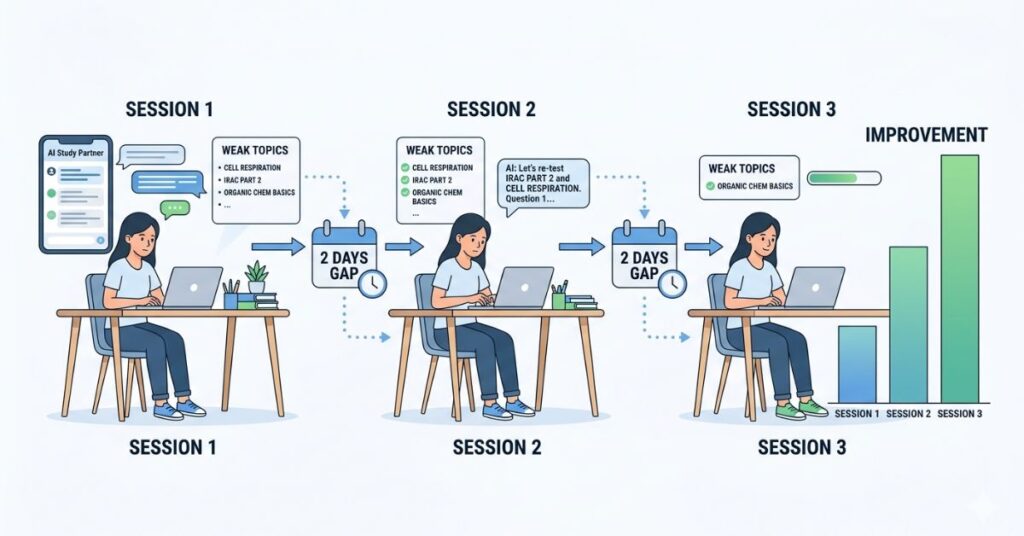
The most powerful thing about this approach is not any individual prompt. It is the system that forms when sessions are connected over time, weaknesses are tracked explicitly, and each new session begins where the last one showed you were not ready.
Most students abandon this part not because it is complicated but because it requires one small act of follow-through at the end of a session when they are tired, slightly relieved it is over, and want to close the app. The act takes ninety seconds.
Send this at the end of every session before closing:
Based on our session today, list every topic, concept, or skill where my answer was incomplete, incorrect, or where I needed a hint to proceed. Rank them from most likely to cost marks in the exam to least.Save that list. Start the next session with:
In our last session, these were my weakest areas: [paste the list]. Before we cover anything new, test me on these areas again using different question formats from last time. If I answer correctly the second time, we move on. If I struggle again, flag this topic for the session after this one too.This creates a manually managed spaced repetition system using AI-generated content. It is less automated than dedicated flashcard software but significantly more flexible, because it can handle complex application questions, essay arguments, and clinical reasoning that flashcard formats handle poorly. The value compounds across sessions in a way that isolated sessions never do, and it requires only that you do not skip the ninety-second tracking step at the end.
Common Mistakes That Produce Weak Sessions
Using AI to receive rather than to produce. Reading AI-generated explanations is the lowest-value use of these tools for exam preparation. Every prompt that asks the AI to explain something to you should be replaced with a prompt that asks the AI to question you about it. Passive receipt of information is not studying for a production task. It is preparation for recognition. If your exam is entirely multiple choice, read explanations. If any part of it requires you to write, argue, or calculate under pressure, use production-mode prompts.
Not providing the exam format in the master prompt. An AI given insufficient context defaults to a generic academic response. A law student preparing for an oral examination needs different practice from one preparing for a written problem paper. A language student preparing for IELTS Task 1 needs different feedback from one preparing for A-Level essay writing. Specify the format. The outputs that follow become meaningfully more targeted.
Skipping the weakness tracking step. The compounding benefit of the tracking system is entirely dependent on continuing it across sessions. A weakness visited once and not returned to fades at approximately the same rate it would have without the session. The end-of-session tracking prompt is where most of the long-term value of this approach accumulates. It is the part most likely to be skipped. Do not skip it.
Using AI to verify uncertain facts without cross-referencing primary sources. AI is reliable for well-established academic content at most exam levels and occasionally makes errors on highly specific clinical protocols, recent legal developments, and content that postdates its training. In subjects where factual precision is critical, end each session with: “Flag any topic we covered today where you are not fully certain of accuracy so I can verify against my course materials.” This single habit produces more confident knowledge than assuming accuracy throughout.
What You Should Do. Step by Step.
Step 1: Write your honest self-assessment right now. Your actual level, your specific weak areas, your exam format, and your date. Save it somewhere you can paste it quickly. This is what opens every session.
Step 2: Open ChatGPT or Google Gemini, send the master prompt with your self-assessment filled in. Do this at the start of every session, not once at the beginning of your study period.
Step 3: Start with the Feynman explanation prompt on a topic you believe you already know well. The results regularly reveal a gap that was invisible until articulation was required.
Step 4: Follow with application or practice problem prompts on the same topic. Understanding tested through Feynman, then tested through application, gives a more complete picture of exam readiness than either technique alone.
Step 5: End the session with the weakness tracking prompt. Save the output before closing.
Step 6: Do not immediately open another session. The time between sessions is when consolidation happens. This is not optional recovery. It is part of the process.
Step 7: In the final two weeks before the exam, stop covering new content. Use only timed practice prompts, essay marking prompts, and timed retrieval sessions. Speed, structure, and production under pressure are what the exam will test.
Step 8: The night before the exam: review the weakness list from all previous sessions. Note anything that appeared more than twice. Review those specific points briefly. Then sleep. What the distributed sessions built is more durable than anything added at midnight, and a rested brain retrieves it more reliably than an exhausted one.
Frequently Asked Questions
Final Thoughts
The student who passed the exam you are preparing for was not necessarily more gifted. In many cases they simply spent their hours differently, not reading more but producing more. Not covering more ground, but returning to the gaps more deliberately, not feeling more confident going in, but knowing more precisely what they did not know and addressing it before it became an expensive surprise on the day.
AI changes what is available to support that kind of studying, not what the studying itself requires. The patient tutor who will generate another practice question at midnight, return to the topic you got wrong three sessions ago with a completely different angle, and mark your essay against the specific criteria of your actual exam: that resource did not exist at any accessible cost for most students until recently. The access is now universal.
Using that access to read summaries is the equivalent of having a brilliant tutor available and asking them to read the textbook to you while you sit there. The prompts in this guide are what actually using it looks like. They require honesty about your real weaknesses rather than comfortable ones, and the discipline to distribute sessions over time rather than compress them when anxiety makes concentration feel more productive than spacing. Those two things are harder than writing a prompt. They are also what determine whether the well-written prompt produces the exam result you need
Once exams are behind you and job applications start, writing your CV with ChatGPT using the same prompt-based approach is the natural next step.
