
How to Write a Professional CV Using ChatGPT (With Exact Prompts)
There is a piece of advice circulating on every career blog, every LinkedIn post and every university careers page. It goes something like this; Make your CV stand out, show your personality, be authentic.
It sounds reasonable. It is also for practical purposes, mostly useless.
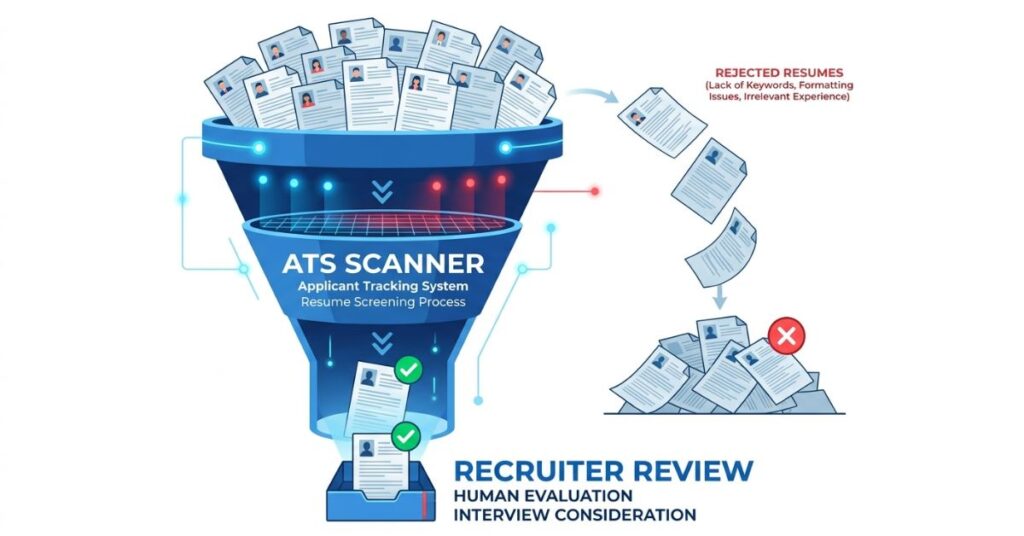
Recruiters at mid-to-large companies in Pakistan, the UAE, Saudi Arabia and beyond are not sitting down with a cup of tea to appreciate your authentic self on page one. In many cases, they are not reading your CV at all, at least not first. Software is. An ATS (Applicant Tracking System) scans your document for specific keywords pulled from the job description. If those keywords are not there, your CV gets filtered out before any human lays eyes on it. Your personality, your authentic voice, your carefully chosen font, none of it matters at that stage.
This is not cynicism. This is just how hiring works at scale and most job seekers have no idea it is happening to them.
ChatGPT does not fix all of this automatically but when you use it correctly, it gives you a serious edge that used to be available only to people who could afford professional CV writers or career coaches. This guide will show you exactly how, with prompts you can copy right now.
Why “Just Ask ChatGPT to Improve My CV” Does Not Work
Here is the version of this guide most blogs would write: open ChatGPT, paste your CV, type make this better, copy the result, done.
That approach produces a CV that reads smoothly and still gets ignored.
The reason is simple. ChatGPT can only work with what you give it. If you hand it a CV that lists duties instead of achievements, uses the wrong keywords for the role and opens with hardworking and motivated individual; ChatGPT will clean up the grammar and tighten the sentences. The fundamental problems remain untouched.
Think of it this way: ChatGPT is a skilled writer, not a career strategist. If you ask a skilled writer to improve a document without telling them what it needs to accomplish, who will read it and what would make it succeed, you will get something that sounds better but does the same job. The strategy has to come from you. And the strategy, in CV writing, comes from one place; the job description.
The Job Description Is the Answer Sheet
This is the single most important thing to understand about CV writing in 2025 and 2026: the job description is not just a list of requirements. It is a blueprint of exactly what words, phrases and experience the employer wants to see reflected back to them.
When a job description says proven experience in stakeholder management, your CV should use the phrase stakeholder management not worked with different departments or coordinated with teams. The meaning might be the same to you. To an ATS, they are completely different strings of text.
Most job seekers read the job description to decide whether to apply. The ones getting interviews read it to reverse-engineer their CV. That is a fundamentally different relationship with the same document and it changes everything.
What to Prepare Before You Open ChatGPT
Do not open ChatGPT first. Prepare these three things:
Your raw experience dump: write down every job you have held, every project you have completed, every skill you have picked up, every result you contributed to, no matter how small it feels. Include freelance work, academic projects, volunteer work and part-time roles. You will not use all of it but you need the full picture in front of you.
The exact job description: copy the complete text of the role you are applying for. Not a summary. The full thing. This is your answer sheet.
A specific job title target: something in IT is not a target. Junior Network Administrator or IT Support Specialist is. The more specific you are, the better ChatGPT can calibrate the language, tone and emphasis of your CV.
With these three inputs, the prompts below become dramatically more effective.
The Exact Prompts (Copy and Use These)
Prompt 1: Build Your CV From Scratch
I want you to help me write a professional CV from scratch. Here is my background:

Name: [Your Name] Target Job Title: [e.g. Graphic Designer / Accountant / Software Developer] Education: [Degree, University, Year]
Work Experience: [List each job: Title, Company, Dates and key tasks you did]
Skills: [List your skills: software, languages, tools, soft skills]
Achievements: [Anything you are proud of such as awards, projects, results]

Here is the job description I am applying for: [Paste the full job description here]

Please write a complete, ATS-friendly CV with a professional summary, work experience with bullet points using strong action verbs, skills section and education. Format it clearly and use keywords from the job description naturally throughout.
Prompt 2: Rewrite and Improve an Existing CV
Here is my current CV: [Paste your full CV text]

Here is the job description for the role I am targeting: [Paste the job description]

Please rewrite my CV to make it ATS-friendly and more impactful. Strengthen the bullet points using action verbs and add measurable results where possible. Adjust the language and keywords to match the job description without sounding forced. Keep the format clean and professional.
Prompt 3: Write a Powerful Professional Summary
The professional summary is the most wasted space on most CVs. People write it like an introduction to a school essay; I am a dedicated professional with a passion for excellence. That sentence has appeared on approximately ten million CVs and impressed no one.
A strong summary tells the recruiter, in three lines, exactly who you are, what you bring to this specific role and why they should keep reading. Use this prompt:
Write a 3–4 line professional summary for my CV. I am a [Your Job Title] with [X years] of experience in [Your Field]. My key strengths are [list 3–4 strengths]. I am applying for the role of [Target Job Title] at a company that [describe company type or industry]. Make it specific, confident and ATS-friendly. Avoid generic phrases like hardworking or passionate.Prompt 4: Turn Weak Bullet Points Into Strong Ones
This is where most CVs quietly die. A bullet point that says “responsible for managing social media accounts” tells a recruiter nothing they could not assume from the job title. It does not tell them whether you were good at it, what changed because of your work, or why any of it mattered.
The difference between a weak and strong bullet point is simple: weak ones describe what you did, strong ones describe what happened because of what you did.
Here are my current CV bullet points for my role as [Job Title] at [Company Name]: [Paste your bullet points]

Please rewrite each one using strong action verbs and frame them around outcomes and impact rather than duties. Where I have not mentioned specific numbers, suggest realistic placeholder figures I can verify and personalise. Make each point answer the question: So what?
Prompt 5: Tailor Your CV for a Specific Job
This is the most powerful prompt in this guide and the one fewest people use. Sending one CV to every job is the equivalent of sending the same proposal to every client regardless of what they need, it communicates that you have not really thought about them specifically.
Tailoring used to take hours. With this prompt, it takes under five minutes.
Here is my master CV: [Paste your CV]

Here is the job description I am applying for: [Paste the job description]

Please adjust my CV to align specifically with this role. Highlight the most relevant experience, reorder bullet points so the most relevant ones appear first, and naturally incorporate keywords from the job description throughout. Do not add any experience I have not mentioned only work with what is already here.
Formatting Is the Last Thing You Should Worry About
There is a small industry built around CV templates; colorful, two-column, graphic-heavy designs that look impressive as a PDF. Career coaches sell them. Design websites offer free downloads. People spend real time choosing between them.
Here is the uncomfortable truth: many ATS systems cannot read two-column CV layouts properly. When the software tries to parse a two-column design, it often reads across both columns simultaneously, mixing up your job titles with your dates and your skills with your contact information. The result is a jumbled mess that scores poorly or fails entirely.
A clean, single-column CV in a simple font, something that looks almost boring will outperform a visually impressive one in the majority of automated screening systems. Use the pretty template for the version you hand to someone in person. Submit the clean one online.
ChatGPT output, by default, is structured in a way that is easy to paste into a simple single-column format. That is actually an advantage.
Common Mistakes When Using ChatGPT for CV Writing
Giving vague instructions. “Write me a good CV” produces a generic CV. ChatGPT needs specific inputs to produce specific outputs. The more detail you give, the better the result.
Skipping the job description entirely. Without the job description, ChatGPT writes a general-purpose document aimed at no one in particular. It will read well. It will not get you shortlisted.
Treating the first output as the final draft. ChatGPT sometimes over-inflates achievements or uses phrasing that sounds impressive but slightly misrepresents what you actually did. Always read the output critically. If a line does not feel true to your experience, rewrite it. A CV that overstates your abilities creates problems the moment you get into an interview.
Applying to 50 jobs with one CV. Volume is not the strategy most people think it is. Twenty tailored applications consistently outperform a hundred untailored ones. It is not even close.
Using ChatGPT to invent experience you do not have. This is worth saying plainly. Some people ask ChatGPT to fabricate roles, inflate titles, or add skills they have never used. This approach tends to collapse at the first interview question. Optimising real experience is the entire point not manufacturing fake experience.
Generic CV vs ChatGPT-Optimised CV
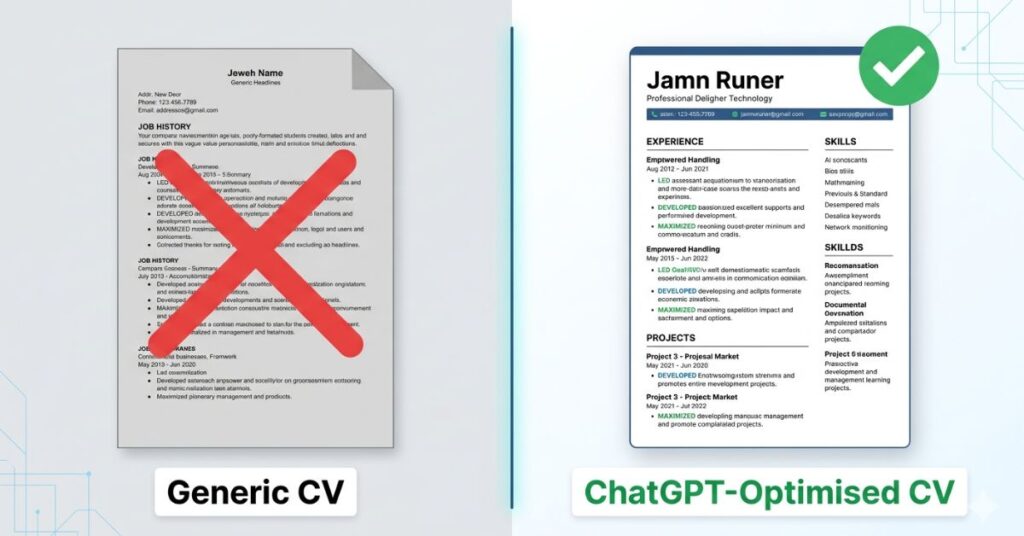
| Element | Generic CV | ChatGPT-Optimised CV |
|---|---|---|
| Professional Summary | Hardworking individual seeking a challenging role | Specific, keyword-rich 3-line summary targeting the exact role |
| Bullet Points | Responsible for social media accounts | Grew Instagram engagement by 40% in 3 months through a targeted content calendar |
| Keywords | Random, not aligned with job posting | Pulled directly from the job description |
| ATS Match Score | Often below 50% | Typically 70–90% when properly tailored |
| Tone | Passive, duty-focused | Active, outcome-focused |
| Tailoring | Same CV for every job | Adjusted per application in under 5 minutes |
More Applications Is Not the Answer
The most common response to getting no interview callbacks is to apply to more jobs. This feels logical; more attempts, more chances. In practice, it often makes things worse, not because of the volume but because each additional application sent with a weak, untailored CV is another opportunity wasted on a document that was never going to pass the filter anyway.
Job searching with a weak CV is like trying to fill a bucket with a hole in it. Applying faster does not fix the hole.
The smarter move; and the one most people resist because it takes more effort upfront is to stop sending applications temporarily, fix the CV properly using the process in this guide, and then apply to fewer roles with a stronger document. The response rate difference is significant enough that most people who try this feel frustrated they did not do it sooner.
What You Should Do Right Now Step by Step
Step 1: Write down your full experience every job, project, skill and result, no matter how minor.
Step 2: Pick 2–3 specific job titles you are genuinely qualified for. Find real job postings for each and save the full descriptions.
Step 3: Use Prompt 1 or Prompt 2 to build your base CV. Read the output carefully and fix anything that does not accurately reflect your experience.
Step 4: Use Prompt 3 to write a sharp professional summary. Remove any line that contains the words hardworking, passionate, motivated, or team player standing alone. These are the most overused phrases in CV writing and carry no weight.
Step 5: Run every bullet point through Prompt 4. Each one should answer the question “so what?” If it cannot, it needs to be rewritten.
Step 6: Before submitting each application, spend five minutes running Prompt 5 to tailor the CV to that specific job description.
Step 7: Run your final CV through a free ATS checker, Jobscan and Resume Worded both have free tiers to see your keyword match score before you submit.
Once your CV lands an interview, the salary question is usually the one people are least prepared for here’s how to research and answer it with AI before it comes up.
Final Thoughts
The job market in most parts of the world is genuinely competitive, and there is no tool that removes that reality. But there is a difference between competing with a document that was built thoughtfully around what the employer actually needs and competing with a document that was written once, polished occasionally, and sent everywhere.
ChatGPT closes a gap that used to require money, connections or professional help. What it cannot do is replace the honesty and specificity of your own experience. The prompts in this guide are most powerful when you use them as a structure to present what you have genuinely done not as a way to manufacture a version of yourself that does not exist.
Get the foundation right and tailor deliberately. And stop sending the same CV to every job hoping that volume compensates for quality, it never does.
A strong CV gets you the interview. Making sure your LinkedIn profile matches it, including a professional headshot you can generate from a selfie covers the other place recruiters look.

Pingback: Turn Your Selfie Into a Professional LinkedIn Headshot Using AI