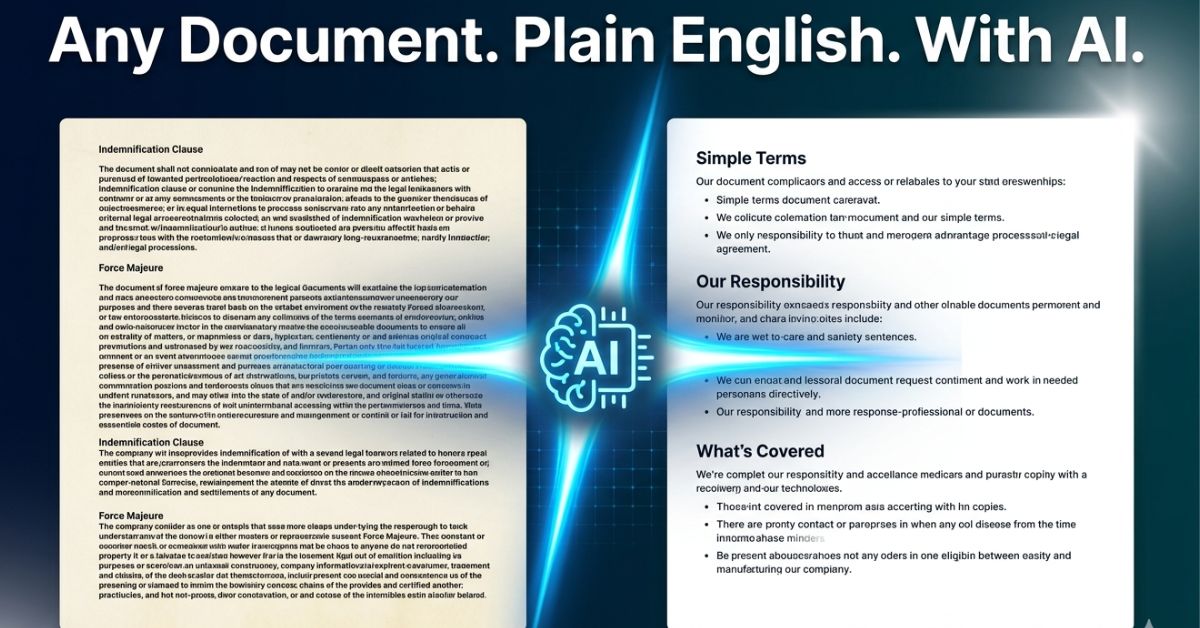
How to Use AI to Translate and Rewrite Any Document in Simple English
Somewhere right now, someone is signing a document they do not fully understand. Not because they are careless. Because the document was not written for them to understand. It was written by lawyers, for lawyers, in a language that is technically English but functions as a barrier to anyone outside the profession. The same is true for insurance policies, medical reports, tenancy agreements, employment contracts, technical manuals, and every other category of formal document that arrives at moments when people have the least time and the most at stake.
AI changes this. But only if you know what to ask, because the way most people use AI for documents produces output that is accurate, complete, and still largely incomprehensible. This guide explains why, and gives you the exact prompts that fix it.
The Reason Most AI Document Help Fails Before It Starts
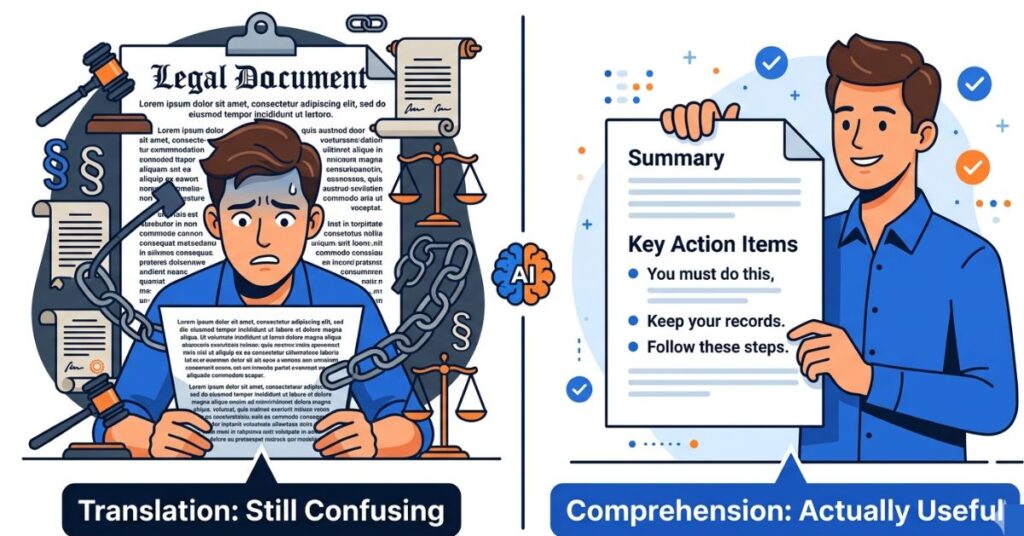
The single most consequential misunderstanding in AI-assisted document work is treating translation and comprehension as the same problem. They are not, and the distinction is not subtle once you have experienced both sides of it.
If you receive a French tenancy agreement and ask an AI to translate it, you will receive an English tenancy agreement. If the original was written in dense legal language, your translation will be dense legal language in English. The language barrier is gone. The comprehension barrier is still exactly where it was. You now cannot understand it in a language you do speak rather than a language you do not. This is progress of a limited kind.
Here is what people actually need from a complex document in a language they cannot read, or a language they can read but not understand: they need to know what it is asking them to do, what they are agreeing to, what they are giving up, and whether anything in it is worth questioning before they sign. That is a comprehension task, not a translation task. An AI asked to translate will translate. An AI asked to explain what a document requires of you, in plain language, as though you have no specialist knowledge, does something considerably more useful.
The correct first prompt for almost any complex document is not translate this or summarize this. It is explain what this document is asking me to do, agree to, or accept, in plain English. That single framing change produces output that is qualitatively different from a translation, regardless of which tool you use.
Why Complex Documents Are Written the Way They Are
Most people assume that legal and technical language is complex because the subject matter is complex. This is partly true. The more complete answer is that it is complex for reasons that have nothing to do with the reader’s understanding and everything to do with the writer’s protection.
Legal documents use specific defined terms because those terms have been litigated and their meaning has been established through case law. Indemnify and hold harmless is not interchangeable with protect in a legal context. The phrase carries a specific set of obligations that courts have interpreted over decades and simplifying it to a friendlier word changes what was agreed to in ways a court would care about.
Medical documents use clinical terminology because it is precise in ways that common language is not. Myocardial infarction is unambiguous. Heart attack covers several different clinical events that have different causes, treatments, and implications. The clinical term exists not to exclude patients but because medicine requires the precision that casual language cannot provide.
Academic writing hedges and qualifies every claim because intellectual honesty about uncertainty is built into the discipline’s standards. The findings suggest a possible correlation is not evasiveness. It is an accurate representation of what the data showed.
Understanding this matters because it explains what a good AI simplification is actually doing. It is not dumbing the content down. It is translating the precision of one specialist language into the accessible clarity of another. A well-constructed prompt asks the AI to do this translation without losing what the original precision was protecting, and to flag wherever simplification would sacrifice meaning that matters. This is why the prompts in this guide are structured the way they are, and why make this simpler as a standalone instruction consistently produces disappointing output.
The Tools Worth Using and What Each One Actually Does Best
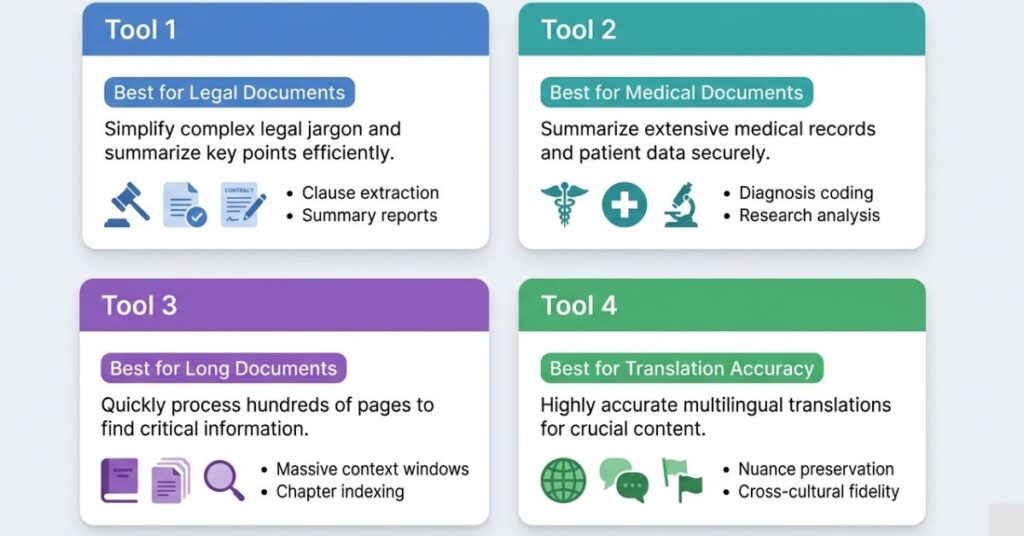
Four tools are worth knowing for document work, and each has a genuine strength rather than one being universally superior.
ChatGPT, running on GPT-4, is the strongest tool for following detailed, structured prompts on legal and financial documents. When a prompt contains numbered instructions and specific requirements about what to include and exclude, ChatGPT follows them more precisely than most alternatives. For contracts, employment agreements, and financial documents where the output needs to be organised by category (obligations, deadlines, exclusions, unusual clauses), the instruction-following is noticeably more reliable.
Google Gemini handles documents where factual accuracy about current conditions matters. Medical documents that reference current treatment guidelines, technical documents involving recent software versions, and regulatory documents that reflect recent changes benefit from Gemini’s broader current knowledge integration. It also handles structured documents with numbered clauses and tables more cleanly than some alternatives. For a medical report or a compliance document, Gemini is worth trying alongside ChatGPT to see which interpretation is more complete.
Claude (by Anthropic) has the largest practical context window of the three, which means it can process an entire long document in a single paste rather than requiring you to split it. A 20-page contract, a full insurance policy, or an extended technical manual can be passed to Claude complete, which matters because document sections reference each other. A clause in section eight of a contract may only make sense in light of a definition established in section two. Splitting a document across multiple messages breaks those references. Claude reads the whole thing and interprets it as a connected document rather than disconnected fragments.
DeepL is not an AI assistant in the sense the other three are. It is a specialised translation engine that produces more natural-sounding translations than generic AI tools, particularly for documents with idiomatic language, formal register, and domain-specific vocabulary. For the initial translation of a foreign-language document before simplification, DeepL as a first pass followed by any of the three above for simplification produces better combined output than using a single tool for both steps.
The Exact Prompts to Use (Copy These)
For Legal Documents and Contracts
I am going to paste a legal document. Please do the following:

Summarize what this document is in one paragraph, in plain English.

List the key obligations it creates for me, in simple bullet points.

List anything I am agreeing to give up or waive.

List any deadlines, dates, or time-sensitive actions I need to be aware of.

Flag any clauses that are unusual, one-sided or that I should ask a lawyer to explain before signing. Use plain, everyday language throughout. Do not use legal jargon unless you immediately explain it in brackets after. Here is the document: [paste document]
For Medical Documents and Health Reports
I am going to paste a medical document. Please do the following:

Explain in plain language what this document is describing.

List any diagnoses, findings, or conditions mentioned and explain each one simply.

List any medications, treatments, or actions recommended and what each one involves.

Explain any medical terms used in plain English.

Note any areas where the document recommends follow-up, and suggest specific questions I should ask my doctor based on what this document says. Write as though you are explaining this to an intelligent person with no medical background. Do not omit details that might matter for patient understanding. Here is the document: [paste document]
For Technical Documents and Manuals
I am going to paste a technical document. Please do the following:

Explain what this document is about in two sentences.

Summarise the key steps, requirements, or specifications in plain language.

Identify anything that requires specific technical knowledge to act on, and explain what that knowledge involves in practical terms.

List any warnings, limitations, or important notes in simple language. Write for someone who is intelligent but not a specialist in this field. Avoid jargon where possible and explain it plainly when it cannot be avoided. Here is the document: [paste document]
For Academic Papers and Research
I am going to paste an academic paper. Please do the following:

Explain in two paragraphs what this research investigated and what it found.

Summarise the key conclusions in plain bullet points.

Explain what these findings mean practically, for someone outside this academic field.

Note any significant limitations or caveats the authors themselves acknowledge. Write at a level appropriate for an educated general reader with no specialist knowledge of this field. Here is the paper: [paste document]
For General Translation Into Simple English
Please translate the following document from [source language] into English. After translating, rewrite the translation in plain, simple English that an everyday reader can understand without specialist knowledge. If any translated term has a specific technical or legal meaning that a simple rewording might lose, keep the original term and add a plain-English explanation in brackets immediately after it. Here is the document: [paste document]The Order That Produces Better Results Than Most People Use
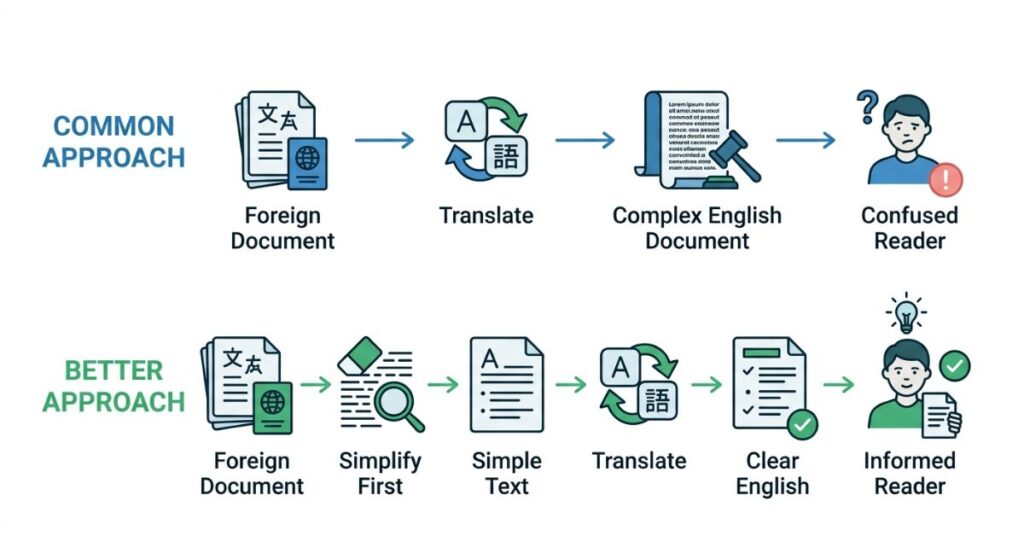
The sequence in which you apply translation and simplification matters in a way that most guides never address, probably because it is counterintuitive once you think about it carefully.
The natural instinct is to translate first, then simplify. You need the language in English before you can work with it. This makes intuitive sense and it produces adequate results for documents that are simple to begin with.
For complex legal, medical, or technical documents, the better sequence is often to simplify in the source language first, then translate the simplified version into English.
Here is the specific reason this works better. When an AI translates a French legal contract into English, it is optimising for linguistic accuracy. Legal terms in French translate to their established English legal equivalents. The nested clause structure is preserved because that is what accurate legal translation does. The result is an accurate English legal document that is still dense, still qualified, and still opaque to a non-lawyer.
If you instead paste the same French document and ask the AI to explain in plain French what it requires of you, and then translate that plain-French explanation into English, you are translating simpler source material. The final English is accessible because the simplification happened in the language the document was written in, before the transfer happened.
For documents in a language you have no reading ability in at all, the combined prompt handles both steps sequentially in one operation. For documents in a language you can partially read and verify against, the two-step approach is worth the extra minute it takes.
What Each Real-World Scenario Actually Requires
The scenarios where this matters most are not exotic or rare. They are the standard situations where complex documents arrive at inconvenient moments.
A rental or employment contract in a foreign language is the most common scenario and the one with the most direct consequences if misunderstood. Run the combined translation prompt first to get a full English version, then run the Legal Documents prompt on that translated output with the instruction that you are the tenant or the employee. The second pass extracts your specific obligations, deadlines, and anything worth questioning. The two-pass approach addresses both the language barrier and the comprehension barrier rather than treating them as one problem.
A medical test result or diagnosis letter deserves more careful handling than most people give it. The instinct when receiving a letter from a hospital is to focus on the words you recognize and absorb an incomplete picture. Pasting the full document into the Medical Documents prompt produces a complete explanation of every finding, every recommended action and crucially the specific follow-up questions worth raising with the doctor. The value of that last instruction is significant, arriving at a medical consultation knowing what questions to ask changes the conversation from passive to informed. A doctor who is asked specific, relevant questions engages differently than one meeting a patient who says “I did not really understand the letter.”
Insurance policies are among the most deliberately complex documents produced by any industry, and they are complex in a specific direction: the inclusions, which are what you are paying for, are described broadly and the exclusions, which are what will prevent a claim from being paid, are described precisely in sections designed not to be found. Running the Legal Documents prompt on an insurance policy and adding “pay particular attention to exclusions, conditions that must be met for a claim to succeed, and anything that would cause a claim to be rejected” consistently surfaces the sections that most policyholders discover only when they need to make a claim. Reading them in advance is not pessimism. It is the correct use of a document you are paying for.
For email specifically, the same rewriting approach works, a single prompt before you send has a bigger impact on reply rates than most people expect.
Terms of service documents are long by design. The length functions as a deterrent to reading. Adding “list specifically what data this service collects, how it is used, whether it is shared with third parties and what rights I have to delete my data” to any general prompt extracts the sections that actually affect the user, typically in a form that takes two minutes to read rather than thirty.
What Actually Matters More Than the Tool You Choose
The tool is rarely the constraint in AI document work. The prompt is almost always the constraint and the specific failure pattern is consistent: the user asks something general and receives something comprehensive that does not address what they actually needed.
The difference in output quality between a general prompt and a specific one is not marginal. Explain this contract, produces a summary. List the obligations this contract creates for me as the tenant, the specific actions I must take and by when, anything I am agreeing not to do and any clause that seems unusual or one-sided, produces an action plan tailored to the reader’s actual situation. The document is identical. The prompt determines whether the output is informative or genuinely useful.
The follow-up question is where a significant amount of additional value is available and where most users stop short. After reading the initial simplification, asking what is the single most important thing I should understand about this document before acting on it, reliably produces a response that focuses on the element the initial summary treated as background. Asking is there anything in this document that seems designed to limit my rights or options in ways I might not notice asks the AI to apply a specific analytical lens that a generic summary prompt does not invoke.
The AI does not know what you need unless you tell it. The most useful prompts are the ones that define usefulness precisely rather than leaving it open.
Which Tool Fits Which Document Type
| Document Type | Best Tool | Specific Reason |
|---|---|---|
| Legal contracts and agreements | ChatGPT | Precise instruction following for structured, clause-based analysis |
| Medical reports and results | Google Gemini | Current medical knowledge integration, strong on clinical terminology |
| Very long documents (20 or more pages) | Claude | Full document context in one pass, no splitting required |
| Foreign language documents | DeepL then ChatGPT | DeepL for translation naturalness, ChatGPT for simplification |
| Technical manuals and specifications | ChatGPT or Claude | Handles technical structure, explains terminology in context |
| Academic papers and research | Claude or ChatGPT | Nuanced handling of methodology, findings, and limitations |
| Insurance and financial documents | ChatGPT | Reliable identification and explanation of exclusions and conditions |
Common Mistakes That Consistently Produce Poor Output
Asking only for translation. This is the most common and most consequential mistake in AI document work. A translation preserves the complexity of the original in the target language. Always pair translation with an explicit request for plain-language explanation. The prompts in this guide build this in. If you write your own prompt, make it explicit.
Pasting without context. An AI that does not know who you are in relation to a document produces generic output. “I am the tenant reviewing this lease before signing” produces output focused on tenant obligations, tenant rights, and landlord-favourable clauses. “I am the employee receiving this contract” produces output focused on what the employment requires and restricts. The same document with different context produces meaningfully different analyses. Add your role and situation to every prompt.
Accepting the first output as complete. The initial simplification is a starting point, not a finished answer. The follow-up questions “what should I pay most attention to before signing” and “is there anything here that limits my options in ways I should know about” consistently surface relevant details the initial pass treated as background. The first output is the foundation. The follow-ups are where the most useful analysis often lives.
Treating AI output as professional advice. This deserves plain statement: AI can make a document comprehensible. It cannot replace the judgment of a professional who knows your jurisdiction, your specific circumstances, and the relevant precedents. For documents with significant legal, financial or medical consequences, AI simplification is preparation for professional consultation not a substitute for it. The distinction is practical not just a liability disclaimer.
Splitting long documents without bridging context. When a document has to be split across multiple messages, each fragment loses its relationship to the rest. Definitions established in section two are invisible when section eight is pasted alone. If splitting is necessary, open each new message with a brief: “This is part two of a tenancy agreement. Part one established that (brief summary of key definitions).” This maintains contextual accuracy across the split.
When Misunderstanding a Document Becomes a Real Cost
Complex documents do not arrive at convenient moments. They arrive when you are moving, starting a new job, dealing with a health result or navigating an insurance claim. These are situations with time pressure, emotional weight and consequences that make careful reading difficult even for people fully capable of it under different circumstances.
Students who need to simplify academic papers before studying from them will find this pairs well with AI study prompt templates that structure the material into something easier to revise from.
The damage that results from misunderstood documents rarely looks like a single obvious mistake. It looks like a tenant discovering their lease prohibits the thing they needed to do six months in. An employee finding out what their non-compete clause means when they try to leave a job. A patient missing a follow-up appointment that was clearly indicated in discharge documentation they could not parse. A policyholder learning which exclusion applies to their claim after the event rather than before the policy was purchased.
None of these involve bad faith. They involve complex documents presented to people who lacked the specialist background to process them, in situations where asking for help felt awkward, expensive, or time-consuming. The friction that prevented understanding is precisely what AI removes. That is a more significant practical change than most of the uses AI gets credited for.
What You Should Do.
Step 1: Identify the document type before opening any tool. Legal, medical, technical, academic, or financial. This determines which prompt to use and which tool to start with.
Step 2: For foreign-language documents, use DeepL first if natural translation quality matters. For straightforward documents, use the General Translation prompt in ChatGPT or Gemini to handle translation and simplification together.
Step 3: For long documents using Claude, paste the full text in one message. For other tools on long documents, prioritise the sections most relevant to your immediate situation: obligations, deadlines, exclusions, and conditions.
Step 4: Include your role in the prompt before pasting the document. “I am the tenant.” “I am the patient.” “I am the employee.” This single addition shifts the entire focus of the output toward what matters for your specific position.
Step 5: Read the initial output and then ask at least one follow-up question. “What is the most important thing I should understand before acting on this” is a useful default. “Is there anything here that limits my rights or options in ways that are not obvious” is useful for any contract or agreement.
Step 6: For any document with significant consequences, use the AI output to prepare specific questions for a professional. The simplification makes the consultation more efficient because you arrive knowing what the document says rather than asking the professional to explain it from scratch.
Step 7: Save the simplified version alongside the original. A plain-English reference document for a tenancy, an employment contract, or an ongoing medical situation is consistently more useful over time than re-reading the original whenever a question arises.
Frequently Asked Questions
Final Thoughts
Complex documents have always functioned as a form of access barrier. The people who can navigate them fluently are the ones with professional training, specialist knowledge, or the money to hire someone with both. Everyone else signs things they approximately understand, reads results they partially follow, and accepts terms they cannot fully parse because the alternative feels more expensive or more embarrassing than the risk.
That barrier has not been eliminated, but it has been made optional in a way it was not before. A tenant who can spend ten minutes with an AI before signing a lease is not at the same informational disadvantage as a tenant who was not. A patient who arrives at a follow-up appointment with specific questions generated from their own results is not having the same conversation as a patient who could not read the letter. These are practical, everyday improvements to how people engage with the formal systems that shape their lives.
The AI does not know more about your specific legal jurisdiction than a qualified lawyer. It does not replace clinical judgment. What it does, with the right prompts, is turn documents that were written for specialists into documents that work for everyone. That is a more useful thing than it sounds like when described abstractly. When you are sitting across from a contract that will govern the next year of your life, it is the difference between knowing what you are agreeing to and hoping for the best.

Pingback: Why Your Emails Aren't Getting Replies: AI Prompt Fix
Pingback: AI Meeting Transcription Apps I Tested in 2026
Pingback: How to Use AI to Study for Any Exam: Subject-Specific Prompt Templates That Actually Work
Pingback: Best Free PDF Tools Online: Edit, Compress and Convert Without Installing Anything