
What to Say When Someone Asks Your Salary Expectations
The first time I was asked this in an interview I said a number. Just volunteered it too low, without any research behind it, mostly because I was nervous and wanted to seem agreeable. Got the job, accepted the offer and found out six months later that the person hired the same week at the same level had negotiated a significantly higher starting salary by doing almost nothing differently except not saying a number first.
That stuck with me for a long time. Not the salary gap itself, though that was annoying, but how little it would have taken to avoid it. I wasn’t bad at the interview. I just hadn’t prepared for that specific question and it’s the kind of question that sounds simple until you’re sitting across from someone waiting for an answer and realize you have no idea what you’re doing.
I’ve used AI to prepare for this question for the past couple of years, and the prompt I run before any negotiation conversation, whether it’s a new job, a contract renewal, or a rate discussion with a client, has changed how I approach it entirely. Not because it gives me a script to read off, but because it forces me to do the thinking beforehand that I used to skip.
Why This Question Is Harder Than It Looks
The salary expectations question is asymmetric in a way most interview questions aren’t. Answer most questions poorly and you’ve hurt your chances. Answer this one poorly in a specific direction and you’ve potentially set a ceiling on your income for years, since raises and future offers tend to compound from whatever baseline you established.
The reason people answer it badly usually isn’t lack of confidence. It’s lack of preparation. They haven’t looked up what the market actually pays for this role in this location. They haven’t figured out their own floor, the number below which the job doesn’t work for them financially, before someone asks for a number under pressure. And they haven’t decided whether they’re going to give a number, give a range or try to deflect and ask what the employer’s budget is.
All three of those are legitimate strategies depending on the situation. The mistake is arriving without a chosen approach and improvising in the moment, which is how you end up saying something too low because it was the first number that came to mind.
The Prompt
This is what I run before any conversation where money is going to come up. I give it context about the specific role and what I know about the company, and it helps me figure out what to say, and more importantly, how to say it so I’m not winging it.
Salary Expectations Prompt: I have an upcoming interview or negotiation conversation where I will likely be asked about my salary expectations. Here is the context:
Role: (job title and brief description)
Company: (company name and any relevant context, size, industry, funding stage if startup)
My experience: (years of relevant experience and key skills)
Location: (city or remote)
What I currently earn or have earned recently: (optional, include if relevant)
What I’ve found in my research: (salary figures from Glassdoor, LinkedIn, job postings or industry reports) Based on this, help me:
1. Identify a specific target number and a realistic range around it, with reasoning
2. Decide whether to give a number first or try to ask what the employer’s budget is, given this situation
3. Write two or three sentences I can actually say in the conversation, in a natural tone, not a rehearsed script
4. Prepare for the follow up: what if they say the budget is lower than my range, or push me for a specific number when I would rather not give one yet.
The reason this works better than just asking AI to “help me negotiate salary” is that it forces you to gather the inputs before you can use the prompt at all. You have to know what the role is, what the market pays and what you’ve earned before the prompt can do anything useful. That research is the actual work. The prompt is the structure that turns it into a response you can use.
What Running This Actually Does
The first thing the prompt usually surfaces is that the number I had in my head going in was wrong. Not by a dramatic amount, but consistently off in one direction, usually too conservative, because my mental benchmark was based on what I would earned before rather than what the current market pays for this role in this location.
That’s the most common version of leaving money on the table. It’s not that people don’t negotiate. It’s that they negotiate from an anchored-too-low starting point, so even a successful negotiation ends below where it should have started. Running the prompt before the conversation recalibrates that before anyone has said a number yet, which is the only time recalibrating actually helps.
It also helps me decide which approach fits the specific situation, which I used to default to guessing. In a first phone screen with a recruiter at a large company that posts salary ranges, trying to ask what the approved range is before giving a number tends to work well. In a final round conversation with a founder who has clearly decided they want me, giving a specific number with reasoning tends to land better than a deflection that reads as stalling. The situations are different and the right approach is different, and the prompt makes that distinction based on context rather than whatever I happened to default to that day.
Nobody Prepares for What Comes After They Give a Number
Most people prepare for giving their number but not for what happens after they give it. The conversation doesn’t end there, and the follow up is often where the actual negotiation happens.
If they come back with a number lower than your range, the instinct is to either accept it or jump to a counter. What works better is a brief pause and a specific question: what flexibility is there, or is the range firm? That single question, asked calmly, opens more room than most people expect. Most employers budget expecting to negotiate, and the initial number is rarely their actual ceiling.
If they push for a specific number when you’ve given a range and want to stay flexible, “I would prefer to stay near the top of that range given the scope of the role” is a complete answer. You don’t have to collapse to a number just because they asked again.
The prompt generates language for both of these follow-up situations based on your specific context, which means you’re not improvising responses to pressure you hadn’t thought through. The improvised version of “they pushed for a number” tends to be the moment people give ground they didn’t have to give.
A Few Things the Research Says That Are Worth Knowing
A few things worth knowing because they matter for how you approach the conversation.
Roughly 70 percent of employers budget above their initial offer expecting candidates to negotiate, and the typical buffer is 10 to 25 percent above what they open with. Walking away from the first number without a single counter is one of the more expensive things you can do in a job search, and most people do it not because they thought about it and decided not to negotiate, but because they hadn’t planned for what to say and the moment passed.
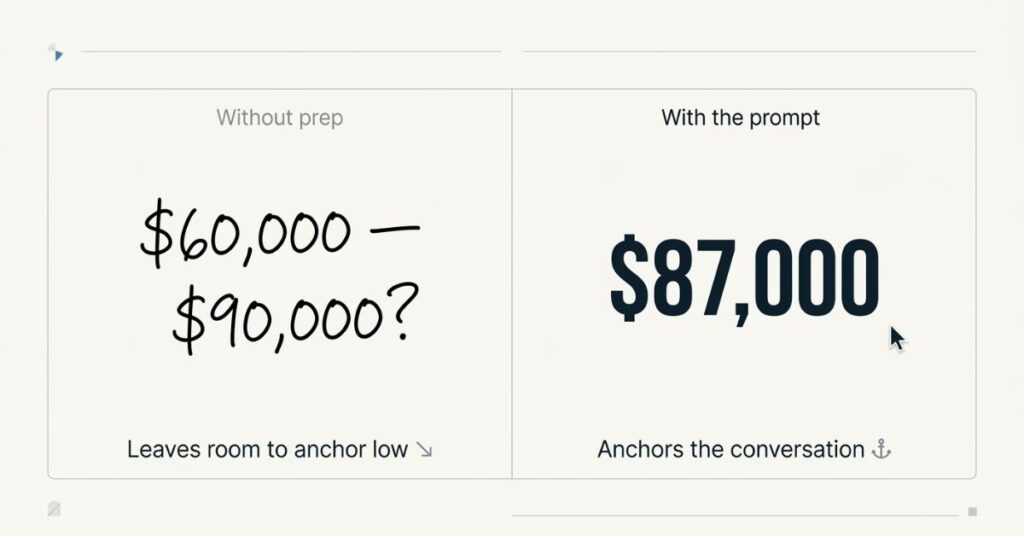
Specific numbers tend to anchor better than ranges. Asking for $87,000 is more likely to result in a negotiation around that number than asking for $80,000 to $90,000, because a range signals the employer to hear the bottom number as your actual target. Research from negotiation studies consistently finds this effect, which is why the prompt asks for a specific target rather than just producing a range and calling it done. If you’ve done enough research to land on a specific figure you can justify, the specific figure is usually the stronger move.
Pay transparency laws now cover more than 16 states in the US, which means job postings in those states are often required to include a salary range. If you’re applying in one of those states and the posting doesn’t include a range, that’s worth noting. If it does include a range, the top of the published range is usually a reasonable starting point for your target, not the middle. Most candidates anchor on the midpoint by default, which means anchoring at the top already puts you ahead of how most people read the same range.
Timing matters more than most people expect too. The conversation about salary that happens after a company has decided it wants you carries completely different leverage than the same conversation during an early screen. The later in the process you can push detailed compensation discussion, the more leverage you have, because the employer has already invested time deciding you’re the right person and switching to another candidate has a real cost. The prompt takes timing into account when it suggests your approach, which is one of the reasons giving it context about where you are in the process produces more useful output than asking a generic negotiation question.
Where People Go Wrong
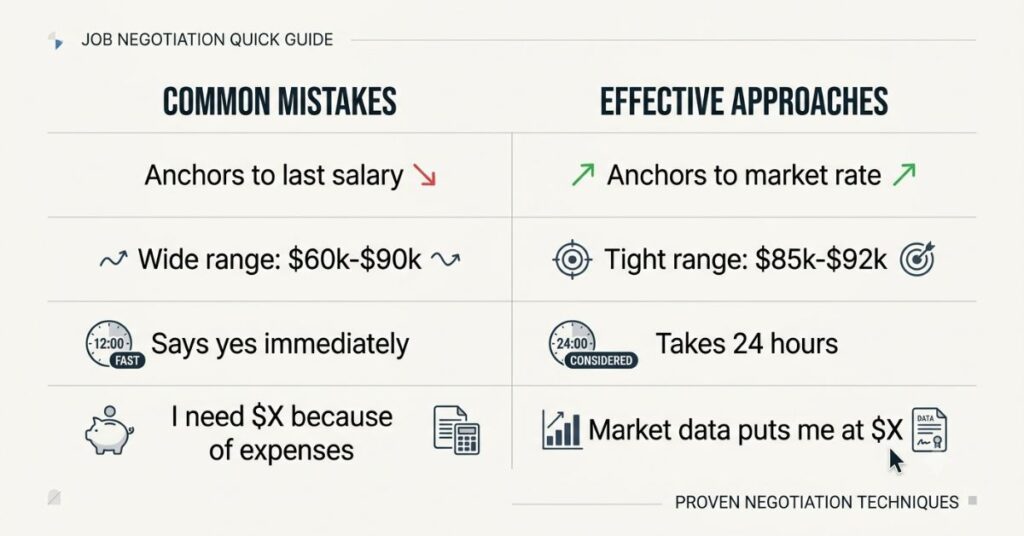
Using the salary from their last job as the anchor for their next one is the most common way this goes badly. Your previous employer’s decision about what to pay you reflects that company’s budget, their pay bands, and whatever leverage you had when you were hired. None of that transfers cleanly to a different company in a different market cycle. What you got paid before is the least useful number in this conversation, and it’s usually the one people walk in most attached to.
Wide ranges are a close second. A spread of $70,000 to $90,000 doesn’t signal flexibility, it signals that you’re not sure, and the employer hears the lower number as the real target. Tighten it. $85,000 to $92,000 with a sentence of reasoning behind it lands completely differently than a guess dressed up as a range.
Accepting immediately is the one that costs people the most invisibly, because it doesn’t feel like a mistake at the time. If an offer comes in at or above what you expected, the instinct is relief and a quick yes. Taking 24 hours costs nothing and occasionally surfaces something worth asking about. Not just the base salary either, start date, remote work arrangement, equity vesting, review timeline. None of these require a confrontational conversation to ask about, and most people never do.
The framing thing is subtler and harder to notice in yourself. “I need $X because of my expenses” and “based on market data for this role, $X is where I land” are asking for the same number but from completely different positions. One frames you as managing a personal budget. The other frames you as someone who’s done research and knows what they’re worth. The language you choose signals which one you are, and interviewers notice.
Comparison Table
| Situation | Approach | What to Avoid |
|---|---|---|
| Early phone screen, no posted range | Ask what the approved range is before giving your number | Volunteering a number too early gives up leverage |
| Final round, employer clearly wants you | Give a specific researched number, not a wide range | A vague range reads as lack of preparation |
| Posted salary range exists | Target the top third of the range, justify with your experience | Anchoring to the midpoint of a range you could negotiate upward |
| They counter below your range | Ask about flexibility calmly before countering | Accepting the first counter without asking if there’s room |
| They push for a number you haven’t given | Give a tight range with reasoning, anchor toward the top | Collapsing to a lower number just because they asked twice |
When This Stops Being Theoretical
There is a version of this where you read it, think it makes sense, and go into the next interview planning to use the prompt but not actually doing the research part first because you ran out of time. That’s the version where it doesn’t help, because the prompt needs real inputs to produce useful outputs. A vague role description and no salary data produces a vague answer.
The version that actually works is running this two or three days before the conversation, when you have time to look up current salary data on Glassdoor, LinkedIn Salary, and a couple of relevant job postings, put actual numbers into the prompt, and sit with what it produces before you decide how to use it. Not the morning of. Not in the car park outside the building. Two or three days before, when there’s still time to change your thinking if the output surprises you.
How to Use This Before Your Next Conversation
Pull up the prompt above and fill in every field you can. For the salary research field use at least two sources, Glassdoor and a current job posting for a similar role are usually enough to triangulate a reasonable range. If you want to make sure the number you land on actually reaches the right person, it helps to pair this with an email that gets a reply. If you’re in a location with pay transparency laws and the posting has a salary range, include it directly.
Read what the prompt produces and notice whether the number it suggests is different from what you had in your head going in. If it is, sit with that gap for a minute before dismissing it. The gap usually exists for a reason, and that reason is usually that your mental anchor was based on the wrong thing.
Then practice saying the number out loud at least once before the conversation. Not rehearsing a script, just getting comfortable with the specific figure in your own voice, because the number that sounds fine in your head sometimes feels oddly large when you actually say it, and that moment of hesitation is something most people can hear.
FAQ
Final Thoughts
The salary expectations question isn’t hard because people don’t know how to negotiate. It’s hard because they walk into it unprepared, with a number in their head that hasn’t been checked against the market, no decision made about which approach they’re taking, and no plan for the follow up. The prompt doesn’t replace the research. It just makes sure the research turns into something you can actually say in a room when someone is waiting for an answer. If you haven’t sorted out your CV before getting to this stage, that’s worth doing first.
